
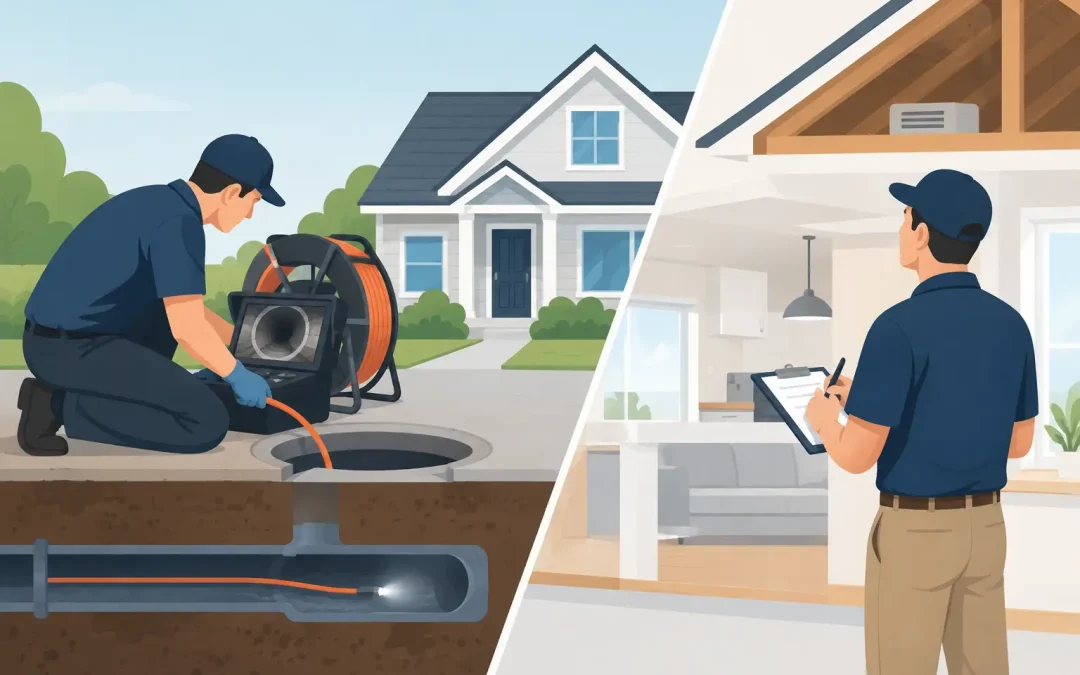
A beautiful kitchen, a clean inspection report, and a quick close can still leave a buyer with one expensive unknown: the condition of the sewer line beneath the property. Sewer scope versus home inspection is not an either-or decision for many buyers. They are different services that answer different questions, and knowing the difference can prevent a major repair from becoming your first surprise after moving in.
A standard home inspection gives you a broad, independent assessment of the home’s visible and accessible systems. A sewer scope uses a specialized camera to look inside a buried drain line that a home inspector generally cannot see. One evaluates the house from foundation to finish. The other investigates a critical pathway below grade.
What a Home Inspection Covers
A pre-purchase home inspection is designed to give buyers a working picture of the property’s current condition. The inspector evaluates readily accessible components and looks for material defects, safety concerns, signs of deferred maintenance, and conditions that may require repair or further evaluation.
That commonly includes the roof, exterior, structure, electrical system, HVAC equipment, plumbing fixtures and visible supply and drain piping, water heater, interior rooms, insulation, doors, windows, and major built-in appliances. The goal is not to certify every component or predict every future failure. It is to identify what is visible, accessible, and significant enough to affect your decision, negotiations, repair planning, or budget.
When testing plumbing fixtures, an inspector may run sinks, tubs, showers, and toilets where conditions allow. This can reveal slow drainage, leaks beneath a sink, an inoperative fixture, or evidence of past water damage. Those observations matter. But water flowing normally during a brief fixture test does not prove that the underground sewer lateral is free of cracks, root intrusion, offsets, bellies, or deteriorated pipe material.
That is where the limitation matters. The sewer line is buried, and much of it may extend beyond the home, beneath landscaping, driveways, patios, or public right-of-way areas. A visual home inspection cannot see through soil or inside the pipe.
Sewer Scope Versus Home Inspection: The Key Difference
A sewer scope is a targeted camera inspection of the sewer lateral, the pipe that carries wastewater from the home to the municipal sewer connection or, in some properties, toward a septic system. A qualified sewer professional inserts a flexible camera through an accessible cleanout or another suitable entry point and records what the camera can see inside the line.
The scope may identify conditions such as root intrusion, cracks, separated joints, pipe offsets, corrosion, scale buildup, standing water, construction debris, or a partial blockage. It may also help identify the pipe material and locate a problem area for further evaluation or repair planning.
A home inspection asks, “What condition is the house in overall?” A sewer scope asks, “What is happening inside this buried drain line?” Both are valuable due diligence, but neither replaces the other.
There are limits to a sewer scope as well. Access may be unavailable, a cleanout may be covered or damaged, the camera may not pass a blockage, or the line may not be fully visible from the available entry point. A scope does not automatically evaluate the home’s water supply line, every branch drain, or the condition of a septic tank and drain field. Ask the sewer provider exactly what portion of the system was viewed, whether video will be provided, and what conditions prevented complete access.
Why Las Vegas-Area Buyers Should Consider Both
In Clark County, the right level of investigation depends on the home, its age, its plumbing history, and the transaction itself. Newer construction is not automatically exempt. Construction debris, installation defects, settlement, and damage from landscaping or later work can affect a newer line. Older homes can carry additional uncertainty, particularly when original pipe materials or undocumented repairs are involved.
Properties with mature landscaping deserve a closer look because roots can find their way into vulnerable joints or cracks. Homes that have undergone additions, major remodels, or converted spaces may also have drainage configurations worth verifying. A recently cleared drain is not necessarily a repaired drain. Clearing a blockage can restore flow temporarily while leaving the underlying cause in place.
Buyers should be especially cautious when the seller discloses recurring backups, drain cleaning, sewer repairs, foul odors, or slow drains. The same is true when an inspection reveals drainage concerns at multiple fixtures, staining around a cleanout, or plumbing repairs with unclear documentation.
A sewer scope is often a reasonable added layer of protection when any of these factors apply:
- The home is older or has an unknown sewer-line history.
- Mature trees or extensive landscaping are near the likely path of the line.
- The seller reports past backups, clogs, root removal, or sewer repairs.
- The home has been remodeled, expanded, or vacant for an extended period.
- You want documentation before accepting responsibility for a buried system repair.
The decision still depends on your risk tolerance and the property. A buyer purchasing a recently built home with clear documentation may view a scope differently than a buyer purchasing an older property with no records. The point is to make that choice with eyes open, not to assume a standard inspection includes a camera examination of the sewer line.
How to Use Both Services During Due Diligence
Timing matters. Schedule the home inspection early enough in your inspection contingency period to review the report, ask questions, and arrange appropriate specialist evaluations. If the property appears to warrant a sewer scope, arranging it promptly gives you time to receive the video and written findings before your decision deadline.
Keep the findings in their proper lanes. A home inspector may identify visible plumbing concerns or conditions that support further evaluation. The sewer professional can then determine whether the buried line has an internal defect, where it is located, and whether cleaning, repair, replacement, or further diagnostic work is appropriate.
Documentation makes a difference in negotiation. If a sewer scope identifies a material issue, request the camera video, a written assessment, and a repair estimate from a qualified contractor. A vague statement that “the sewer has a problem” is harder to evaluate than evidence showing the location, condition, and recommended repair approach.
Then consider the practical choices. Depending on the condition, your agent may help you request a seller repair, a credit, a price adjustment, or additional time for evaluation. Not every finding should end a transaction. A minor buildup may call for routine maintenance, while a collapsed or severely deteriorated line may justify a much larger discussion. The right response depends on repair scope, cost, property value, and your willingness to take on the work after closing.
Kelleher Home Inspections helps buyers understand the visible condition of a property with detailed digital reporting, photos, video where applicable, and an organized request list for repair conversations. When a condition falls outside the scope of a general inspection, the responsible next step is clear: obtain the right specialist evaluation before closing rather than relying on assumptions.
Questions to Ask Before Ordering a Sewer Scope
Before you schedule, confirm whether the provider can access the line through a cleanout and whether the price includes video and a written report. Ask how far the camera is expected to travel, whether they can locate defects from the surface, and what happens if the camera cannot pass a blockage.
It is also wise to ask whether the inspection covers the private lateral only or extends to the connection point. Municipal responsibility often begins at a particular point, but the exact boundary can vary. Do not assume that a problem near the street is someone else’s responsibility without confirmation.
A home purchase has enough moving parts without discovering that a major buried system was never evaluated. A thorough home inspection sets the bar high for what can be seen and tested at the property. When the home’s age, history, or visible clues raise questions about the drain line, a sewer scope gives you a clearer view of what is below ground – and a better chance to act before the keys change hands.
Recent Comments